Showing posts with label Mishaps. Show all posts

Monday, January 28, 2019

The Smoking Finger

No, I don't have one of those fancy new fangled phones
that take photos, so I put what's left of my index finger in the scanner.
Surgeons and nurses toiling in an operating room become habituated to a very controlled environment where everything from lighting to air quality is subject to rigid regimentation. Unpredictable events throw a monkey wrench in the midst of this enforced order, often times, leading to a cascade of adverse events  which can result in personal  injury to staff.

Voice modulation morphs into a surgeons unduly harsh verbal  admonishment of the offending party. Harried nurses, desperate for a resolution to the problem throw caution to the wind and find themselves in a precarious situation while attempting to solve the problem. Desperation seldom leads to reasoned thinking. The ensuing pandemonium is enough to flummox a pope.

Operating rooms can be dangerous places. Surgeons waiting for someone to fall asleep before cutting them might, at face value, seem unsavory, but the notion of live by the sword; die by the sword holds true in the OR.  Those sharpened chunks of stainless steel do not discriminate when inflicting their trauma and Bovies don't care what  tissue they roast.

 As a circulating nurse I was known for constructing elaborate platforms for height challenged scrub nurses. My colleague, Janess, loved my elevation tactics and was so enamored with one of my creations she failed to notice an unusually low hanging overhead light. As she emergently  ascended my stairway to operating room heaven for an urgent trauma case,  the crown of her head struck the low hanging illuminary with a sickening THUD..CRASH. After finishing the case, a close inspection of her cranial vertex revealed a hematoma the size of the distal end of a Babcock. After a quick neuro check and 15 minutes with an ice pack she was back on duty. I've witnessed several intraoperative injuries to staff and not a single nurse or surgeon broke scrub, no matter the extent of the injury.

Karma can be a cruel mistress and I soon received my payback for contributing to Janess's unfortunate mishap. I was finishing up a case with Dr. Oddo that entailed resecting a menengioma. These tumors are outside the brain and with removal have an excellent prognosis. I was in a great mood thinking about how we were actually being  of some service to the poor soul suffering from this nasty,  neoplastic malady. One thing I've learned over the years is to be wary of those euphoric Kumbaya moments when everything seems to fall in place because a true shitstorm is often in the works.

Dr. Oddo had been using a foot pedal actuated Mallis bipolar cautery during the case. This nifty little device looks like a pair of tweezers with an electric cord attached to a high voltage generator. When Dr. Oddo tramped on his foot pedal electricity flowed between the tips of the tweezer like device cauterizing anything in between. It was a great little gadget for controlling bleeding in small vessels.

Dr. Oddo loved to instruct the anesthetist to lighten the anesthesia near the end of a case. One  of his favorite phrases in the post-op report was, "The patient was able to transfer from the OR table to the awaiting carriage independently." This sometimes made for exciting moments near the end of surgeries when the patient took ambulatory surgery to a new level and decided to bail out before the final skin sutures were in place.

Sure enough, just as Dr. Oddo started closing the skin flap the patient began to emerge from general anesthesia. As he came to, his right leg spasmed into a mighty lateral kicking motion impacting Dr. Oddo's leg poised with his foot just above the Bovie actuating pedal. I was tidying up by clearing off the operative field and was preparing to wipe down the distal, business end of the Bovie forceps. The patients kick to the good doctor's leg turned the Bovie forceps ON and as the juice flowed a sickening burnt flesh/charred rubber glove malodorous scent filled the air.

The Bovie had cooked my right index finger on the distal phalange. As the smoke cleared I requested a new glove and plunged  what was left of  my smoking finger into a fresh sterile barrier. There must be some truth to the notion the body releases pain killers when traumatized because initially I was pain free. Upon finishing the case and pealing off the second glove the extent of the injury became apparent. The end of my finger had extensive "remodeling" with the distal aspect about 1/3 AWOL.

Dr. Oddo helped me remove the melted latex glove from the wound and suggested wrapping the finger with iodoform gauze. Dr. Slambow was consulted and said "welcome to the club" while showing off a massive scar on his right palm. After about 4 weeks, it was time for the unveiling. Dr. Oddo involved himself in a spirited debate with Dr. Slambow questioning whether  the nasty blackish tissue around the wound was eschar or scar tissue.

After the unveiling and the scar/eschar mess was pealed off I had a functional but rather disfigured index finger with a square tip and missing 1/2 the nail. I never missed a day of work and today I regard what's left of the end of that finger as a badge of honor. It's better than thinking of it as a living monument to my foolishness.

Sunday, December 9, 2018

Is Surgery A Spectator Sport?

Observers in a sanctioned overhead viewing site 
advancing their surgical acumen. Serendipitous 
snoopers were another story.
Vintage hospitals went to great lengths to provide surgeon and/or nurse wannabes the opportunity to observe surgeries. European hospitals even referred to their operating rooms as "theaters."  I once worked with a charming British surgeon that affectionately  referred to  us "theater nurses." This soft spoken man actually  thanked  us personally after a case was finished even if our performance was not up to snuff.  A different breed of surgeon compared to his American colleagues.

Surgical spectators were all different and the most interesting  involved the serendipitous observer who happened to be in the right wrong place at the time of the surgical experience.  Don't get me started on those whippersnapperrns who freely use that confounded "experience" word to describe a planned operative  anatomical alteration, but I figure if you can't beat 'em, join 'em. Who says you can't teach an old dog new tricks?

The operating rooms where I toiled were on the very top floor of the hospital and offered a beautiful view of Lake Michigan which was 8 blocks due East. Large picture windows offered surgeons and nurses the opportunity to feast their  weary eyeballs on a  tranquil visual treat of sailboats and sparkling blue water far off in the distance. A welcome reprieve from eyeball stinging Bovie smoke and squnting to thread fine needles with 8-0 white silk while a surgeon hollered at you in the background for being too slow for his speedy needle plunges.

Everything was fine and dandy until the esteemed members of the hospital board decided to erect a high rise employee housing palace  next to the hospital. Nurses were agitated because these were luxury apartments and unaffordable for all but the most privleged office sitters. We were stuck in our 3rd floor walk ups where heat was a rarity even on the coldest winter nights.

Various members of Chicago's building trades toiled on the construction crews erecting this palace for the medical center moguls. They were a cast of colorful characters to say the least. Ironworkers in particular were a flamboyant, in your face sort of personality. I think it had something to do with their performing hazardous work at elevations where one false move meant falling many stories to a colorful  death.

As the building began to rise, we eagerly watched the progress while standing at the scrub sink which was probably less than 50 feet away from the ascending steel I-beams. You  could hear the ironworkers incessant babble before you could see them.   We joked with the surgeons that the ironworkers must be afficionados of expensive German automobiles just like them because they bantered constantly about "beamers" while guiding the gigantic steel beams into place.

The merriment came to an abrupt halt when the ironworkers ascended to the level of the operating room windows. This rag tag bunch of haggard workers acted as though they found a visual paradise. They glared and made contorted expressions as they avidly observed the goings on in the operating rooms. If they found the proceedings in one room not to their liking a short stroll along the steel beam provided a different procedure to observe. Legitimate surgical observers were limited to viewing the proceedings in just one room while the ironworkers enjoyed a virtual cafeteria of surgical sightseeing.

Their ringleader with his distinctive orange striped  hardhat led his merry men along a steel beam parallel to the OR windows until they found a procedure to their liking. The cysto room was the least popular after a worker nearly stumbled off a beam while observing a meatotomy. That procedure shivered my timbers too, so I could empathize with their revulsion.

The most popular room for these happenstance journeymen observers was the orthopedic room. A hammer is a hammer whether the one doing the hammering is a surgeon or an ironworker. The orthopedic surgeons were kept busy reducing and stabilizing bones just as the tradesmen were with steel beams. Both used lag screws and plates in their work. A brotherhood of sorts was established.

The surgeons took little notice of these nosey nitwits, but nurses thought the activities bordered on voyeurism and should be halted. Plan "A" was to scare them off. Sponge racks were crude, nasty looking devices ostensibly designed to facilitate counts, but really served to provide the surgeon of a visual reminder of blood loss. These morbid contraptions were wheeled, so positioning loaded sponge racks dripping with blood  in front of the windows worked to frighten off the men of steel. Some nurses took to displaying suction bottles full of blood on the window sills, but gradually the men of steel acclimated to our repulsive displays.

Alice, our beloved supervisor came up with the ultimate solution to the problem. Being an ultimate Killjoy, she used autoclave tape to suspend surgical drapes over the windows. some problems work themselves out with benign neglect. The observation opportunity ended with our move to the new operating rooms in the Stone Pavilion. Windowless operating rooms were very popular in the mid 1970s and put an abrupt halt to all the fun.


Thursday, May 3, 2018

Glass IV Bottles - Breaking Bad

Breaking a  glass IV bottle was the stuff nightmares were made of. There were three elements to
consider with shattering  old time glass IV bottles. The glass bottle, a liter of fluid (D5W took the prize for making the biggest mess due to it's inherent stickiness,) and an air gap. The air in the bottle served to amplify the crash of the glass breaking so as to sound almost like a rifle shot. Hearing that booming "CRACK" followed by a piercing scream alerted the entire floor of the mishap and summoned a legion of gawkers for the messy clean up. It was an unwritten rule that the clean up was the sole responsibility of the unfortunate breaker of the bottle - don't even thing about calling for a janitor, oops, I mean housekeeping person. An empty Cardboard IV case was placed on the floor close to the broken glass which was gingerly pushed  into the enclosure with a portion of the box top. The procedure always reminded me of catching a piranha  with your bare hands, a slippery mess with a laceration or bite close at hand.

Glass IV bottles were at risk for breakage because their girth made them difficult to grasp. When CDs were designed one of the goals to make them easy to handle. Designers of glass IV bottles were not concerned with ergonomics and the diameter of the glass  container expanded to fit the volume of the fluid. Thank heaven there were no 2 liter  IV bottles.

Another common mechanism of bottle breaking was undershooting the hanging notch on the IV pole. That thin wire hanger was difficult to see especially under bad lighting conditions and many an old nurse thought the bottle was about to nest safely on the pole only to have it come crashing down. A good luck/bad luck conundrum occurred when the rapidly descending bottle came crashing down on the nurse's foot. The bottle, cushioned by the nurse's toes remained intact but hobbled the hapless nurse. Maybe nurses should have worn steel toe shoes like heavy construction workers.

Miss Bruiser, my all time favorite nursing instructor had a favorite tactic for dealing with bottle breaking students. After haranguing and berating the student during the clean up she insisted the clumsy student carry a glass IV bottle with them for 24 hours. A unique combination of public humiliation and learning how to perform daily activities with an ever present glass IV bottle was an excellent deterrent.

Finally the rolly polly crash and break was another way to reduce the glass bottles to glistening shards.  Everyone was acutely aware that there was only one safe position for a glass IV bottle and that was vertical. Inadvertently setting a glass bottle on it's side resulted in it rolling away and crashing at some distance from the nurse. Nurses frequently turned the bottle to this vulnerable position to apply a timing strip or write a note on the bottle label. This unfortunate event almost always occurred at times of great stress when there was an unforeseen complication or unexpected event. An acute hypoglycemic crisis required an immediate IV and if that gigantic ampule of D50 rolled and shattered it was like having a bull in an IHOP restaurant with all those syrup bottles; sticky, gooey syrupy stuff everywhere.

Despite the potential for breaking, nurses hated to see those glass IV bottles morph into those silly looking flexible plastic bags. If the complaints and derisive comments about heavy duty enema cans being replaced by flimsy bags was bad, the ill will directed toward IV bags was even worse. Veteran nurses used to joke  ( I hope it was in jest)  about using those newfangled flexible plastic IV bags for enemas because that was about all they were suited for.

Friday, October 13, 2017

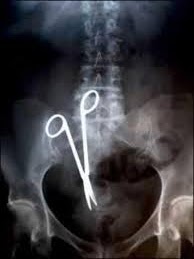
A Friday the 13th Foreign Body Mishap??

What does this X-ray reveal?  Looks like the scrub
nurse was preoccupied by counting sponges and over-
looked keeping track of the instruments. That looks
just like a straight Mayo scissors at waist level


Foreign body false alarm. That's just an x-ray of a student
nurse in uniform toting scissors in the standard location.
When a snip was needed, student nurses could pull those
scissors out faster than an outlaw cowboy could draw a
six shooter.


Tuesday, March 15, 2016

Brand New Operating Rooms - Brand New SNAFUS

Our wonderful new operating  suite of 11 rooms labeled "A" thru "K" had been under construction since 1971 and now 3 years later was open for business. They had been designed by an architect that had no previous OR design experience, but he would eventually marry the OR  supervisor who wisely departed before the grand opening ceremony. We all knew how he got the job. Not a single staff nurse was consulted about the design. A love-struck inexperienced architect being influenced by a blow hard supervisor with no recent clinical experience; What could go wrong?

The rooms had all sorts of grand features including a conveyor belt system running underneath the rooms for linen and garbage removal. In operation, the only thing this system did was make unpredictable very loud bangs and BOOMS during such critical surgical events like aneurysm clippings or aortic clamping. Of course the agitated surgeons vented their angst by screaming at the scrub nurse who had nothing to do with the racket. The conveyor belt system was up and running a grand total of  3 days before it was mothballed for good. We hiked back up to our old abandoned  tiled temple of an operating room suite and retrieved our faithful old wheeled trash bins and carts. They worked like a charm as they had for the 60 previous years.

The next dilemma was the room nomenclature. Our old rooms were numbered "1" thru "12" which was a simple, time tested measure. When someone said room "4" everyone was on the same page. Over the new OR intercom room "B" sounded just like room "D"  We should have taken a tip from police officers and given each letter a uniform call sign. We started making up novel call names for the letters. "I'm in room "H" as in hemorrhage and need all the packed cells I can get!" was probably typical. We came up with some really descriptive call signs for the lettered rooms, but soon learned it was better to avoid monikers denoting surgical complications. Some of the less imaginative surgeons were becoming agitated.

Our new locker rooms were located one floor above the actual operating rooms. To access the ORs, a short elevator ride was necessary. Stepping out of the elevator was akin to the curtain raising on an X  rated theater production. The elevator opened directly in front of the huge window looking into a cysto room giving the elevator occupants a shocking (to some nonmedical personnel) prime time view of someone up in stirrups awaiting God knows what of a urological  procedure.  I always thought urology instruments were some of the most frightening looking and thought provoking. I used to wonder, "How is that huge resectoscope going to fit in that tiny little opening?"

 The surgeons and nurses did not bat an eyelash as the elevator doors unveiled the cysto room sights, but some of the schedulers and secretaries were shocked. Soon one of the administrative personnel constructed a make shift curtain from a surgical drape partially obscuring the view from the elevator landing.  The chief of urology was appalled and ripped the drape from the window bellowing, "This is a teaching hospital. Not a top secret research lab. If anyone doesn't want to see what's going on here they can drape their eyes."  I guess that was an old, foolish attempt at the "transparency" business we hear ad nauseum today. The drape was never replaced, but in a compromise move, the OR table was moved so as to be at a right angle to the door.

This next SNAFU haunts me to this very day. There was a time tested sterilization procedure in the old tiled temple for our instrument trays. They were carefully wrapped, tagged with autoclave tape and sterilized in one gigantic autoclave in central supply. This autoclave was nearly the size of an Eldorado and carefully monitored with each firing recorded on graph paper.

The neophyte OR designer came up with a concept that bordered on genius if you listened to the OR supervisor now turned architect's fiancĂ©. Each operating room "A" thru "K" was equipped with a puny little double-doored autocalve. The unwrapped instrument trays were shoved into the mini-autoclaves from the outside hall and sterilized for a 3 minute cycle which was consistent with how we had "flash" sterilized individual instruments in the old tiled temple. This mini autoclave stroke of genius idea created a painful hot potato scenario for the hapless scrub nurse.

When the autoclave door was opened in the operating room after a 3 minute cycle, the nurses were first greeted with a blast of steam and the scrub nurse then had scalding hot instruments to handle. I can tell you from personal experience that latex surgical gloves have virtually no insulating property. This issue was especially acute with heavy instruments like retractors and speculums. We tried to cool the scalding hot instruments with irrigant but this was like treating cancer with a band aid.

After a few weeks in operation, it was noticed that our infection rate in the new operating rooms had soared. Of course it was the nurses fault. Administration even cultured our nostrils and told us to sharpen up our aseptic technique.

 I am no expert on thermodynamics but always wondered about the time it took for the instrument trays to reach an effective temperature, figuring that if they were hard to cool, they were hard to heat.. One day a representative from the autoclave manufacturer showed up and told the supervisors that the autoclaves were never designed to sterilize a complete instrument tray in 3 minutes and that the autoclaves were being used in a way that was inconsistent with their design.

I have never witnessed as much finger pointing and she said-he said monkey business following the autoclave SNAFU. The correction was to extend the autoclave cycle to 10 minutes after reaching the correct temperature. I don't think it was ever nailed down where the 3 minute cycle idea initiated.

When the 4 story  Rich Insurance Dude Pavilion was constructed in 1970, the planners envisioned a hospital high rise in the sky probably inspired by the Sears Tower.  A ton of money was spent on a heavy duty foundation to support this hospital skyscraper of the future. A few years ago when I returned for a visit, I noticed the skyscraper concept never got off the ground, To this day, the pavilion is a measley  4 stories tall  and they are back to sterilizing their surgical instruments in a central location. Not all big-time plans work out as planned.

Monday, March 7, 2016

Perineal Fallout - A Scourge in the Operating Room

After making a brief mention of countermeasures to prevent perineal fallout in my last post, I received a couple of questions via email. I decided the best way to answer them would be to interview an expert, Alice, an operating room  nurse from the greatest generation here to enlighten us aging baby boomers and whippersnapperrns as well.  Alice hates foolishness, so if you don't want to be permanently stuck in the cysto room hanging endless bottles of irrigant, pay close attention.

Alice, (background)  wearing perineal fallout detecting headgear
on duty in the  never ending war against infection inducing perineums.

Alice, "What exactly is perineal fallout?"
If you recall from your most basic anatomy class, the skin is composed of layers. The outer layer is continually being sloughed off into the atmosphere forming a potentially infectious fog that spreads like radiation. It is especially prevelant where skin rubs together in areas like hairy masculine thighs or other skin folds.  

Is perineal fallout a gender issue restricted to men?
No of course not. In my Operating Rooms, women wear scrub skirts as orderd in the Bible. Just read Deuteronomy 22:5. Women wear undergarments under their skirts that trap and contain perineal fallout so it's not a big issue.. Who knows what those hairy surgeons have under those baggy scrub pants, but I suspect there are huge colonies of microorganisms just itching to be set free and cause a very nasty infection.

What can be done to prevent dreaded perineal fallout?
Like everything else in nursing, an ounce of prevention is worth a pound of cure. Men should always have perineal fallout contained by ankle constrictions. I'm from the old school and back in my day we had scrub pants with elastic ankles. This worked like a charm. The best substitute for elastic cuffs, that I've come up with is rubber bands so the next time you unwrap your copy of The Chicago Tribune, be sure to save the rubber band and bring it to work. Waste not - Want not.

Years ago we had other measures to combat those pesky crotch bacteria. One of my all time surgical heroes, Joseph Lister, sprayed carbolic acid  all around the room during surgery. I don't want any complaints about that caustic fog of carbolic acid burning your eyes or constricting your airway, it's one of the sacrifices we make for our patient in the never ending battle against perineal fallout.
A wardrobe failure of catastrophic proportion resulting in spontaneous
release of perineal fallout. This is the operating room equivalent of the Chernobyl
disaster. Fallout all over the place. Even the "Alice approved" rubber banded ankle
trick is useless as a containment measure. Maybe Lister's carbolic spray needs resurrected.


Alice was a true crusader in the battle against perineal fallout. Sometimes nurses that came before me harbored customs and beliefs that were not rooted in science. The way I viewed the perineal fallout issue was that any escaping microorganisms would wind up on the floor which was by it's nature is contaminated. So what is the big deal?

 It did not really pay to argue with people like Alice. Empirical beliefs that stood the test of time were usually very fixed. I don't know if modern nurses have encountered this issue, but perineal fallout made for much argument and discussion back in the day. About the only people Alice could cajole into her rubber banding were hapless first year residents. Too much arguing with attending surgeons was hazardous to continued employment.

Alice would really have fun with OR staff and nurses in general now that everyone wears scrub pants which were her true nemesis if found sans her ever present rubber bands.