Sunday, January 30, 2022

Thursday, January 27, 2022

Life Before Piped in Oxygen - Tanks A Lot

Physiology pivots on the oxygen pinnacle

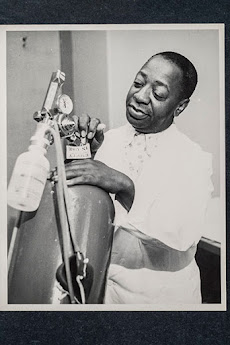
I thought those gigantic "H" cylinders of oxygen, not to be confused with their lesser sized brotherern, would be with us forever in the hospital. Oxygen delivered to wall outlets in patient's rooms seemed like a pipe dream because we had enough problems with our common old ordinary plumbing. There were steam leaks from autoclave pipes that resembled Old Faithful and recurrent problems with clogged drains. Pipes and problems went together like tweedle dee and tweedle dumb. How in the world could this ever work with a gas under high pressure?

I couldn't imagine oxygen pipes being exempt from similar pipe problems and, of course, I was an ace with the skills necessary to course these massive green cylinders around and about hospital wards and halls. Who needs fancy piped in O2?  A weak mind and a strong back were the only prerequisites for being an oxygen delivery boy, and of course the eager nurses and cyanotic patients were always overjoyed to see me with my life sustaining cargo. Just what a fragile adolescent male cast adrift in a sea of estrogen needed for an ego boost. I was really doing something worthwhile! This is why I chose nursing as a career instead of an auto mechanic.

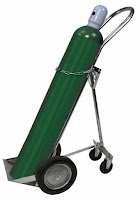
Oxygen tank storage rooms were special places and out of bounds for most of the fairer sex. Green monsters chained to 2X12 wooden planks and weighing in at over 150 pounds required some muscle and lots of practice to safely handle. I used a trusty dolly to transport these bemouths and once they were set in motion inertia took over. Stopping these rolling monsters was akin to putting the brakes on a battleship.

The other tricky part was maintaining the correct incline while tipping the dolly into position. There were dollys with training wheels for the more cautious, but the tiny caster like wheels used on the trainer support system were prone to gyrating like a belly dancer and slowing the entire delivery process. It was no fun pushing these bruisers down a hospital corridor with those tiny wheels doing the watutsi.

Training wheels also impaired the ability to maneuver the tank into position at the patient's bedside. It was possible to fine tune the position of the tanks when it was released from the dolly by carefully rolling the base of the tank which was all fun and games until you rolled an "H" cylinder over your toes. I preferred the dolly sans training wheels.

Alas, all good things must come to an end, and the conversion of cavernous hospital wards to semi-private rooms was a game changer. Wrestling a colossal "H" oxygen cylinder into the cramped confines of puny 2 bed hospital room was akin to stuffing an elephant into a phone booth, these green monsters longed for the circus big top of a spacious ward where there was ample room to roam.

The construction required to section off individual rooms from the big tent arena of a hospital ward provided an opportunity to run pipelines for the bedside delivery of oxygen, and an end to wrestling with the big green monsters.

Endings like this are usually bittersweet. Yes, piped in oxygen was very convenient, but the bedside delivery of something as life sustaining as oxygen afforded the delivery boy an entire cosmos of goodwill. It was heartwarming to witness the relief and gratitude of patients and nurses alike, while I quickly switched out regulator yokes and twisted my oxygen wrench to the on position and noted the swing of the needle on the pressure gauge from near empty to full, good for another few days of life sustaining oxygen. I was transformed from lowly delivery boy to a genuine care giver and that was good enough for me.


Monday, January 3, 2022

Roller Clamps Were Pioneers in IV Fluid Regulation


The past is like a foreign country where things are done differently, before the extravagant complexity of intravenous pumps and controllers, simple little roller clamps ruled the roost when it came to IV regulation. I was totally fascinated by these clever little gizmos and even had a collection of vintage roller clamps that I recently unearthed from my nursing archives basement junk hoard. 

These unsung heroes of the IV therapy universe deserve further study as they are not as simple as they appear. An injection molded cage with wheel guides molded into the sides to accept the axles of the adjustment wheel is the most obvious feature. When the wheel is positioned at the top of the housing an uncompromised flow of IV fluid ensues. The device must apply just the right amount of friction to the plastic tube to remain stationary while leaving the lumen of the IV tube wide open, not an easy task. The device then had to regulate the flow of IV fluid by changing the lumen of the IV tubing as the nurse turned the adjustment wheel.

There was strict dogma delineating the correct position of the clamp on the tubing.  Our rigid, uncompromising diploma school instructors insisted on having the roller clamp positioned about 2 inches below the drip chamber so as to be able to locate it in the dark. Old nurses never, ever flashed on blinding overhead room lights at night. Sleep was revered as a healing agent. Having the clamp just below the drip chamber made it easy to locate at night.

There were 2 methods of establishing a flow control region within the clamp housing and one entailed the wheel traveling along an inclined ramp molded into the bottom wall of the device. The other entailed a clamp with the base parallel to the open wheel access port, not a ramp in sight!  The wheel guides were inclined so the wheel traveled at an angle to the base of the clamp whereas the wheel was much closer to the bottom of the clamp when rolled down. The pressure on the IV tubing was varied by the up and down movement control wheel as it moved along the inclinations in the wheel guides.

Some really fancy roller clamps were dual action in that both a ramp and a variable inclinable control wheel changed the lumen of the IV tube. Some things in nursing made no sense and one of the most common places to find these over engineered, exquisite roller clamps was on clysis sets that were used to give fluids subcutaneously. Drip regulation on clysis sets was not a big deal, so why the fancy roller clamps?  Some mysteries are never solved, especially in nursing, but that's a topic for another day.

 Clysis sets were really old school and not subject to medical supply companies seeking to maximize profit margins by making cheaper roller clamps. Travenol clysis sets with dual action clamps even had metal axle spindles on the control wheels. I'm sure it would have been more cost effective to injection mold the wheel and axle in one piece. No cost was spared in producing these roller clamp gems.( For more foolishness on clysis:  https://oldfoolrn.blogspot.com/2015/07/down-quart-hypodermoclysis-to-rescue.html . )

One of the problems with roller clamps was a phenomenon called control point drift which occurred when the control wheel spontaneously moved to a region of less pressure increasing the lumen of the IV tube resulting in increased flow rate. Definitely not a good thing, especially when titrating vasopressors. The dual action clamps with metal control wheels were rock solid once adjusted. The increased  friction exerted by the metal spindles effectively attenuated control point drift.

Another problem with roller clamps involved the properties of the PVC intravenous tubing itself. After adjustment a phenomenon known as cold flow creep sometimes occurred. The lumen of the IV tube would decrease even though there was no movement of the control wheel. Lengthening the control zone on the clamp helped control this problem. Generally speaking, the longer the roller clamp the more stable the infusion rate. Short, stout roller clamps could be a real bear to regulate, some nurses even resorted to taping the control wheel in place.

The labor investment required by manual IV control was considerable because roller clamps needed frequent adjustment, but who would you like to see standing at your bedside, a concerned nurse or a noise barfing electronic poseur? Roller clamps also limited the number of IVs that could be managed on a ward. On a 30 bed unit the maximum number of  running IVs was abour six. Roller clamps are long gone, but not forgotten.

Wednesday, December 15, 2021

Rethinking Nursing Awards

It's been many moons since I've posted and I'm certain all three of my regular readers miss my foolishness as much as I miss their astute comments. When it comes down to posting on my blog or navel gazing, the later always seems to win out.

 I wonder how anyone can be a regular reader of an intermittent blogger  unless they are like regularly irregular like cardiac arrhythmias,...oops there I go with more of that philosophical navel gazing stuff. Well it's time to grind out some of that patented foolishness that I'm famous for and what better place to start than with that time honored tradition of nursing awards?

I've  noted a recent plethora of nonsensical  nursing awards. Let's see there is the ever popular Daisey award and the Rubber Duckey award (No foolin'). One medical center was even handing out rocks as an award. Strange indeed. Most of the folks handing out nurse awards are hard core members of the dreaded nurse academic/administrative office sitter complex who have mastered a type of feel good jargon with absolutely no clue about what actually transpires during bedside nursing care.  Without further ado let's get into some real world nursing awards from the perspective of the tried and true bedside practitioner.

The first award is the aptly named The Golden Goose award which is given to the most whacky and useless nursing research project. I never could deduce the role of nursing research which should be aligned with biology and physiology, not psychology and sociology. What's wrong with clinical research if our goal is to improve patient care?

Drumroll please...the Golden Goose is awarded to a study with the impressive question; "Does photic stimulation impact hypovigilant states in the hospitalized patient?" If a research question can be easily answered, it's probably not a good one to study, and heck yes, turning on the sonic boom equivalent of lighting in a hospital room wakes patients up. We used to sneak around with great stealth using flashlights so I cannot understand where the notion of turning on the bright overhead lights came from.

I suspect it might have something to do with utilization review nurses and their never-ending quest to give patients the boot out the front door ASAP. Making the hospital environment as inhospitable as possible is a fail safe method to encourage patient egress in an expedicious manner.


My next award is aptly named "The Bermuda Triangle" and Head nurse Annie whose exploits I've detailed in a previous post is the hands down winner of this honor. Annie's fait accompli was making problems disappear into thin air. One memorable escapade involved a litigious patient falling from an allegedly defective hospital bed. The bed had been sequestered in an unused room awaiting inspection by a representative from the plaintiff's lawyer.  Annie contacted a nursing school on the other side of the city and offered them a free bed for their nursing practice lab. All they had to do was provide transportation which was arranged through a friendly police officer hanging out in the ER. In Chicago, paddy wagons are called "squadrols" and they just happened to perfectly accommodate a hospital bed.

The Marcel Marceau Award goes to one of my favorite OR colleagues, Janess, who was a strict devotee of that old school axiom that scrub nurses are better seen than heard. Every OR nurse recognizes the wrist flick gesture for a needle holder or the index, 2nd finger sign for scissors. but Janess had a few special movements that were just between us. A modified throat slashing gesture meant that our dreaded nemesis, Alice, the noisebarfing supervisor was approaching with her usual dose of venom and it was time to lay low. She also had a unique taffey pulling like gesture for a retractor that was most impressive and cemented her qualifications to receive such an esteemed honor.

The next award is really something special and it's called the starfish award, coined after the aquatic creature's unique ability to heal on its own accord by growing new limbs. Corazon Amuro is the deserving recipient of this honor.

She was the sole survivor of a demented serial killer named Richard Speck who invaded a Chicago apartment where 9 student nurses were living. Ms. Amuro was the sole survivor and witnessed the blood bath from beneath a bed as Speck strangled, stabbed, and slashed his way through the tenement.

When asked about her recovery she replied that there was no counseling and that she sustained herself by working hard as a nurse. To her, nursing was not a means to an end. Nursing was the end itself. She took care of others and was grateful for her 1966 salary of about $4.00 an hour.


Friday, October 29, 2021

O.R. Poem

 Find me a place

where the overheads shine bright

and the hollering gives fright.

Find me a suture that closes just right

and a patient that awakes without

a pathology that gives a great fright.


I remember a young scrub nurse

hiding from the world.

Find me all these things

And that is where you'll find me.

Thursday, September 9, 2021

Needle Gauge Sizing Explained

Hmm...It's easier for a camel to pass through
the eye of a needle than avoid Miss Bruiser's
painful ministrations!

Sizing of most medical implements made sense, gloves were measured by running a tape measure across the mid section of the hand, the measurement in inches was the glove size. Catheters were measured in Fr. and one French was equal to 1/3 mm. a 32 Fr. catheter was most definitely larger than a 26 Fr.  Endotracheal tube diameters are measured in simple millimeters. Nice and straightforward for foolish folks like myself.

Needle caliber sizing is a horse of a different color. Miss Bruiser, my favorite nursing instructor insisted that physical discomfort (pain) was required for a  student nurse's proper education, so when she gave us a choice of needle size for injection practice sessions it was obviously a trick question. Her beady little eyes shifted like a pinball in play when she asked, "Now which size needle would you like me to use on your tender deltoid when I demonstrate an intramuscular injection technique, A 16ga or a 22ga?" Well a 16ga sounded like the best choice because the logical thought process would deduce that 16 is less than 22 so the needle would be of a smaller caliber  and hurt less when harpooned by a towering Miss Bruiser. Well we were dead wrong and had the bloody aching arms to prove it.

 Every nurse knows that the smaller the gauge number, the bigger the needle, but how in blue blazes did this come about? Up until the dawn of the 20th century there was no standard for needle size other than puny, medium, and jumbo. Thanks to the British wire industry things were about to change.

Needle sizing is a direct descendant of ye ol'  Birmingham wire gauge which was widely used as an industrial standard in merry old England. According to this standard a #1 gauge wire had a diameter of 6.26mm  which was used as a starting point for the measurement of wire diameters. The number of wires that could fit in this defined area was the gauge. It's easy to see that for an area of 6 mm diameter (or there abouts) to accommodate 25 strands of wire they would have to be much, much less of a diameter than say #12 gauge to occupy the exact same area. The greater the number of wires ram rodded into the same sized area, the lesser the diameter. So that's why the higher the needle gauge, the smaller the diameter of the needle. I'll take getting harpooned with 27 gauge needle over a 16 gauge any day!

As time went on, the Birmingham wire gauge was further improved and made more exacting for the sizing of medical needles by meticulously defining the steps between the different gauges, for 7-14 gauge needles the size increased by .025 mm for each larger size needle, to 19 gauge the size increased by .013mm, and lastly with the small needles size increased by .0064 mm. When you think about tiny needles, just a small decrease in gauge can make a really big difference so that's why the steps between gauges are so small.

The year 1955 was an occasion for old nurses to celebrate. Roeher Products introduced the disposable Monoject syringe which allowed for a choice of needle size which was independent of the syringe. The color coding of needle sizes was born and every nurse knew a bright  red needle guard signified a 25 ga needle and a blue guard meant a 21 ga. I never could figure out why a 20 ga needle and a 25 ga had the same reddish  color, although the 20 guage was of a very light shade. 

The needle that gave every novice nurse the tremblors was not a monster 16ga, but rather the mighty 2 inch long.Imferon needle with the purple guard. I shudder to think of the misery Miss Bruiser could inflict with one of these monsters as it bounced off periosteum with a loud clunk followed by an ear splitting shriek!

Tuesday, July 6, 2021

Portrait of the Scrub Nurse As an Artist


Yep...I hijacked the title to this post from that great Irish literary genius, James Joyce, whose near blindness probably enhanced his writing ability by excluding extraneous stimuli. Operating rooms, on the other hand, have loads of stimuli, but they are certainly nothing to look at. The stark, tiled walls and hard unforgiving terrazo floors almost call out for beautification and just about anything  aesthetically pleasing is a huge step forward.

Scrub nurses have a variety of artistic media available to them right on their Mayo stand and  each individual has their own style. My attempts were crude compared to some of the Rembrandt like efforts of today's youngsters.  I'll give a brief account of my lame efforts and then morph into some truly beautiful work by contemporary artists scrub nurses and scrub techs.

My initial  artistic endeavors involved cutting various designs in my sharps bag which was really nothing more than a plain old waxed brown paper container. A straight Mayo scissors was the perfect cutting tool and I began with profiles of hearts on the sides of the bag. After all, any operating room could use a little more love.

 As my skills advanced, flowing scalloped edges inspired by the Rococo school of art adorned the top of my sharps bag. Ratcheting a needle out of my driver and dumping it  in the sharps bag had a new found feeling of artistic fulfillment as I watched it drop past those lovely scallops. Simple pleasures for simple minds.

In the 1970's the hottest new innovation in surgical draping was a material called Vi Drape which was nothing more than a sheet of polyurethane with an adhesive backing. After prepping, a sheet of Vi Drape was applied to the skin and the surgeon made his incision smack dab through the Vi Drape. No cutting corners here!  The idea was to isolate the skin from the surgical site to prevent infection. Vi Drape also provided a sterile platform for plopping an organ down on it without fear of contamination.

Before the skin sutures were thrown in place, the Vi Drape was pealed off and unceremoniously tossed in the ever ready kick bucket. While removing a used Vi Drape from the bucket, I noticed how the overhead lights illuminated it, creating a stunning design. The center of the drape that had been incised glowed like a twinkling star and it was surrounded by a lovely pinkish glow thanks to the retained Zepharin prep solution. Pink tinged Zepharin was certainly more pleasant to look at than the yucky brown Betadine prep which is so ubiquitous today. The speckling added by blood droplets and minitissue chunks highlighted the brilliant center of the design.

How could I display this masterpiece? The answer was no further than an unused light box used to view X-Rays in our break room. I archivally preserved my masterpiece by sealing it in unused Vi Drape and secured it to the light box. There was mixed reaction from my fellow nurses. Some loved it while others thought I was nuts. Art is supposed to get folks talking and asking questions so I fulfilled my purpose.

Now for the good stuff. Orthopedic surgery provides whippersnapperns with a great media for sculpture, namely bone cement. Marjorie RN at bloodgutsandcoffee on Instagram has some really great work displayed on her posts. The sample on the left has even been enhanced with what is apparently Methylene blue and a surgical marking pen. How cool is that.

Orthopedic surgery also provides for brief "time snacks" while portable X-rays are taken. What a perfect time for artistic endeavors. Every moment of pseudo leisure can be put to good use in the OR. Sculpting with bone cement is surely lots more fun than gazing at that yucky blood/bone chip slurry reposing at your feet.

When I was a youngster, surgical marking tools were limited to a tooth pick and a medicine glass filled with methylene blue. To mark an area the tooth pick was dipped in the dye and dabbed in place, a crude method which did not lend itself to intricate designs or sketches.

Today, it's a different story. There are all sorts of surgical marking tools that are not only useful in marking patient's skin, but also function great as a means of artistic expression. The canvas is a surgical towel or mayo stand cover. Surgidoodle on Instagram has some of the most intricate and lovely designs I have ever seen. This "circle of time" is one of my favorites and the way the tips of a pair of Babcock clamps  point directly to the serpents head is really spooky. Maybe someone is about to snag that serpent in the jaws of their Babcock and free that omniscient eye lurking in the center. Who knows!


Surgidoodle also has a simply elegant work on her Instagram page titled SHARK ATTACK. You won't get any of that artsy fartsy sillyspeak from me on this magnificent work. It's simply beyond description. The contrast between the stark line drawing of the attack with the severed lower extremity and the ambiguity  of the bloody mottled background make us consider the complexly entangled lives we lead in the OR. Heavy stuff, indeed.

Shark Attack has all the elements of  a quintessential work of fine art: A life altering event frozen in time, the sometimes random element of trauma infliction, how trauma dissociation is based on evolutionary survival behavior, how invalidated trauma generates silent internal screams,  and an inquiry of the survivability of traumatic injury. The assorted components cohere into an elegant whole that transcends the harsh, unforgiving environment of the tiled temple. Compared with the wan, self involved art (I'm thinking of the Andy Warhol Museum here in Pittsburgh,) which strain for undeserved and unearned profundity, Shark Attack is in a class by itself!


If I have piqued your interest in operating room artists here is a listing of some of the ones I enjoy on Instagram.

ortho_artistry features some very nice bone cement sculpture work

operatingroomart shows us some lovely abstract images created by a urologist with a cystoscope and gel.  Absolutely more colorful than a meatotomy!

surgeryboxcartoons shows what can be done with a surgical head covering container.

And of course surgidoodle which is my all time favorite. Thanks for inspiring me to finally get around to posting something. 

.